
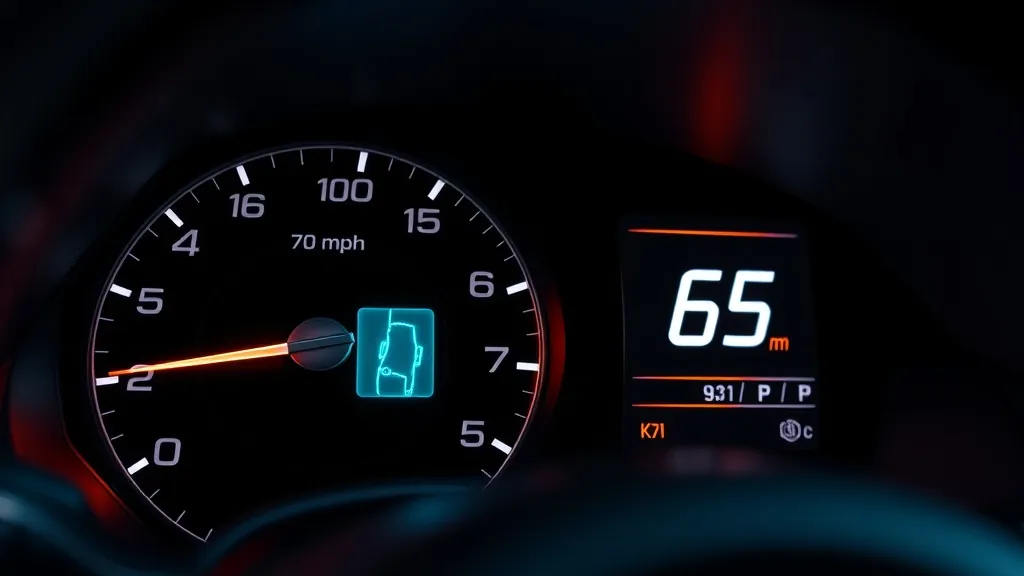
If your GPS app consistently shows a lower speed than your dashboard, you have not found a bug — you have found a feature. US law requires car speedometers to never read low, so manufacturers intentionally build in an upward bias. Here is exactly how it works.
The federal rule: speedometers must not under-read
The National Highway Traffic Safety Administration (NHTSA) standard FMVSS 101 requires that at any speed above 25 mph, a car’s speedometer must not indicate a speed lower than the vehicle’s actual speed. There is no rule against reading high. Result: every manufacturer builds in a safety buffer of 3–10 %.
How much does your speedometer read high?
At an indicated 70 mph you are typically travelling at 64–68 mph true ground speed. A GPS speedometer will confirm this. Use the Speedometer Accuracy Calculator to enter your tyre size and get a precise correction factor for your specific vehicle.
Tyre wear amplifies the error
Your speedometer is calibrated for the factory tyre size at its nominal diameter. As tyres wear down (losing 1–3 mm of tread depth), the rolling circumference shrinks, so each wheel rotation covers less ground. The speedometer still calculates speed based on the original diameter — so it reads even higher. Fitting larger aftermarket tyres can flip this, making the speedometer read low (illegal).
Why this matters at speed cameras
UK speed cameras measure true ground speed. US LIDAR speed guns also measure true speed. If your indicated speed is 72 mph and a camera clocks you at 67 mph, you are fine. But if your indicated speed is 68 mph and you think you have a buffer, you may actually be at 70 mph true — right at the limit. A GPS HUD shows your real ground speed so you know exactly where you stand.
The practical solution
A GPS head-up display reads your true speed via satellite positioning and is unaffected by tyre size, wear or manufacturer bias. It sits in your line of sight so you always know your real speed at a glance.
As an Amazon Associate, HUDScreen earns from qualifying purchases. Pricing and availability are shown on Amazon and may change.
Frequently asked questions
Is it legal for a speedometer to read high?
Yes. US federal standard FMVSS 101 prohibits speedometers from reading below actual speed but places no upper limit. Manufacturers typically set a 3–8% upward bias to stay safely within the law.
How much does tyre wear affect speedometer accuracy?
A significantly worn tyre (losing ~2mm of tread) can increase the speedometer error by an additional 1–2%. New wide aftermarket tyres can go the other way, making the speedo read low — which is technically illegal and rare in practice.
Can I recalibrate my speedometer for new tyres?
Some vehicles allow electronic speedometer recalibration through the dealer or a tuning tool. Otherwise, the most practical solution is a GPS HUD that always shows true speed regardless of tyre size.