
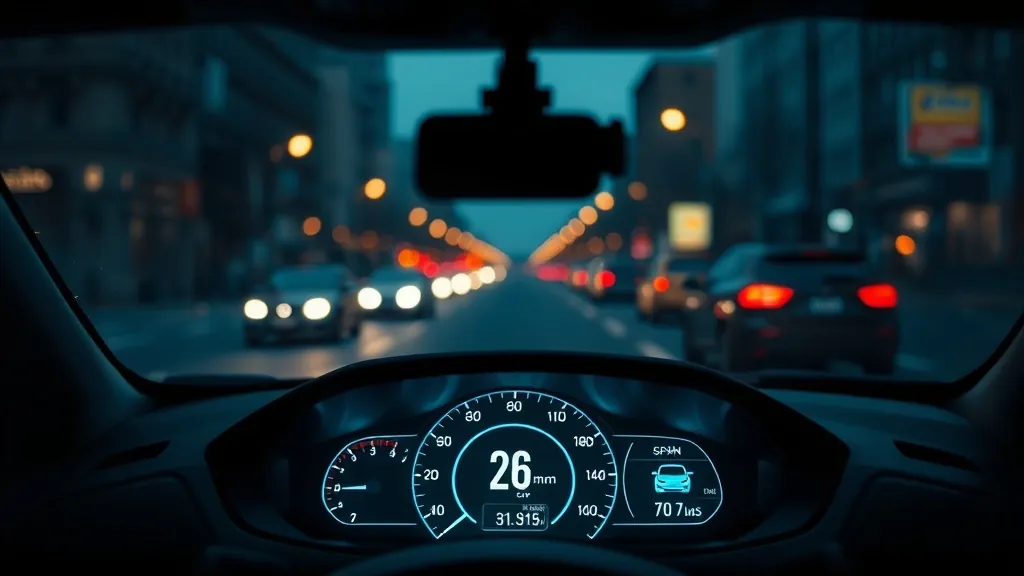
A head-up display and a smart dash cam are both popular driver-safety devices, but they solve different problems. Understanding the distinction makes it easier to decide which to buy first — and whether you want both.
What a head-up display does (proactive)
A HUD for your car is a proactive safety device. It puts speed, engine data, and turn-by-turn directions in your line of sight while you are driving, reducing the need to look away from the road. Its job is to help you avoid an incident in the first place.
A HUD does not record anything. It has no memory, no storage, and no replay function. Its value is entirely in what it helps you do differently while driving.
What a smart dash cam does (reactive)
A dash cam is a reactive safety device. It records your journey continuously to a memory card and stores a clip automatically when the accelerometer detects a collision. Its job is to provide evidence after something has already gone wrong — insurance disputes, hit-and-run incidents, or fraudulent claims.
A dash cam does not help you drive better. You never look at it while driving; it simply runs in the background.
The case for having both
Because they serve different purposes, many drivers eventually add both. The HUD reduces the chances of an incident; the dash cam protects you when incidents happen despite your best efforts. They do not overlap or interfere with each other — a dash cam typically mounts at the top of the windshield; a HUD display sits low on the dash.
Which to buy first?
- Buy a HUD first if you want to improve your driving immediately: speed awareness, engine monitoring, overspeed alerts. Our KUOWEIHUD K1 is our budget pick.
- Buy a dash cam first if you drive in high-incident areas, have had disputes with other drivers, or want the insurance protection that footage provides.
- Buy both for comprehensive coverage. The two fit comfortably in any car without interfering with each other.
Note: some all-in-one products combine a dash cam with a front-facing display. These hybrid units exist but are a compromise — the display typically cannot project onto the windshield like a dedicated HUD, and dash cam quality is usually secondary to the recording function in combined units.
As an Amazon Associate, HUDScreen earns from qualifying purchases. Pricing and availability are shown on Amazon and may change.
Our HUD picks
Three plug-in head-up displays, by what you want on the windshield.
 KUOWEIHUD K1 GPS Head-Up Speed DisplayGPS speed with no OBD2 port needed: fits EVs, hybrids and older cars.Check Price →
 wiiyii P6 OBD2 + GPS Head-Up DisplaySpeed, RPM and temperature from the OBD2 port on compatible 2007+ gas cars.Check Price →
 VIVIHUD HUD-V5 Wireless CarPlay & Android Auto HUDWireless CarPlay and Android Auto directions plus GPS speed.Check Price →
As an Amazon Associate, HUDScreen earns from qualifying purchases. Price, shipping and returns are set by Amazon and the seller.
Frequently asked questions
Is a head-up display or a dash cam better for safety?
They provide different types of safety. A HUD is proactive — it keeps your eyes on the road and gives you real-time alerts while driving. A dash cam is reactive — it records evidence after an incident. A HUD improves how you drive; a dash cam protects you after something goes wrong. Both are useful, and they don’t conflict.
Can a head-up display also record footage like a dash cam?
No. A dedicated head-up display is a display-only device — it has no camera, storage, or recording capability. Its job is to show you information while you drive. For recording, you need a separate dash cam.
Do dash cam HUD combos work as well as separate units?
Generally not as well as purpose-built devices. All-in-one combo units typically compromise on both HUD display quality (no windshield projection) and dash cam resolution. Separate, dedicated units are better at their respective jobs for a similar combined price.
Is a HUD camera the same as a head-up display?
No. A HUD (head-up display) projects speed and driving data into your line of sight; it does not record video. A dash camera records the road for evidence but shows nothing on the windshield. Some combo units advertise a “HUD camera,” but a dedicated HUD and a dedicated dash cam each do their one job better.
What is a HUD dash display?
A HUD dash display sits on the dashboard and projects speed, RPM and other data onto the windshield above it — keeping your eyes up instead of dropping to the gauge cluster. GPS models fit any car; OBD2 models add live engine data on compatible gas cars.