

A BMW head-up display retrofit is one of the most-searched BMW modifications — and one of the most misunderstood. Fitting the factory HUD to a car that left the plant without it is far more involved than most listings suggest. Here is the full picture for F30, F10, E60, F40 and X5 owners.
What an OEM BMW HUD retrofit actually requires
The factory system is not a single part. A genuine retrofit generally needs all of the following:
- The HUD projector unit itself, matched to your chassis and model year.
- A HUD-compatible windshield. This is the step people miss. BMW HUD windshields carry a special wedge-shaped interlayer that prevents a double image. A standard windshield produces visible ghosting, so a full windshield replacement is usually required.
- Wiring and trim — the loom to the unit plus a revised dashboard trim panel with the HUD aperture.
- Coding. The car’s modules must be recoded (with ISTA/E-Sys or equivalent) to enable the option and register the new hardware.
Add those together and an OEM retrofit typically runs into four figures, with the windshield and labour dominating the cost.
Why is my BMW head-up display greyed out?
If the HUD menu appears in iDrive but is greyed out and unselectable, the car’s software knows about the option but the hardware is either not fitted or not coded. Common causes:
- The retrofit hardware is installed but the vehicle order (VO) has not been coded to include the HUD option.
- The projector unit is faulty or not communicating on the bus.
- The menu entry exists generically for the model range even though your car never had the option — in that case there is nothing to enable without the hardware.
A greyed-out menu on its own is not evidence that your car has a hidden HUD waiting to be switched on. That is a persistent myth.
Chassis-by-chassis notes
- F30 (3 Series, 2012–2019) — the most commonly attempted retrofit. Hardware is widely available used, but the HUD windshield and coding still apply.
- F10 (5 Series, 2010–2017) — similar to F30. Full-colour HUD on later builds; make sure the unit matches your build date and iDrive generation.
- E60 (5 Series, 2003–2010) — the earliest BMW HUD generation, monochrome and low resolution by modern standards. Parts are scarce and integration is fiddly; rarely worth the effort today.
- F40 (1 Series, 2019+) and X5 — newer platforms with more integrated electronics, which usually means more coding complexity, not less.
- MINI — MINI models use a combiner-style projection panel rather than windshield projection, so a MINI retrofit is a different parts list again.
The practical alternative: an aftermarket HUD
For most owners the honest recommendation is an aftermarket unit. An OBD2 HUD plugs into the standard OBD2 port that every BMW since 1996 has, needs no windshield change, no coding and no trim removal, and can be moved to another car later. It shows GPS-verified speed plus RPM, coolant temperature and voltage.
You lose the factory-integrated look and navigation arrows sourced from iDrive. You gain a five-minute install and a fraction of the cost. See our BMW HUD display picks and the broader factory vs aftermarket comparison.
Already have a factory HUD that stopped working? See BMW factory HUD not working?
As an Amazon Associate, HUDScreen earns from qualifying purchases. Pricing and availability are shown on Amazon and may change.
Our HUD picks
Three plug-in head-up displays, by what you want on the windshield.
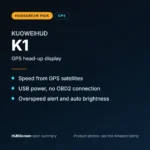 KUOWEIHUD K1 GPS Head-Up Speed DisplayGPS speed with no OBD2 port needed: fits EVs, hybrids and older cars.Check Price →
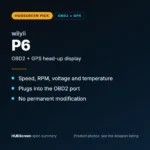 wiiyii P6 OBD2 + GPS Head-Up DisplaySpeed, RPM and temperature from the OBD2 port on compatible 2007+ gas cars.Check Price →
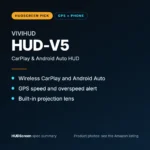 VIVIHUD HUD-V5 Wireless CarPlay & Android Auto HUDWireless CarPlay and Android Auto directions plus GPS speed.Check Price →
As an Amazon Associate, HUDScreen earns from qualifying purchases. Price, shipping and returns are set by Amazon and the seller.
Frequently asked questions
Can you retrofit a head-up display to a BMW?
Yes, but a genuine OEM retrofit needs the projector unit, a HUD-compatible windshield with a special wedge interlayer, the wiring and trim, and module coding to enable the option. It typically costs four figures. An aftermarket OBD2 HUD achieves eyes-up speed and engine data in about five minutes with no coding or windshield work.
Why is my BMW head-up display greyed out?
A greyed-out HUD entry in iDrive means the software knows the option exists but the hardware is either absent, faulty, or not coded into the vehicle order. It does not mean a hidden HUD can simply be switched on — without the projector and a HUD windshield there is nothing to enable.
Do you need a special windshield for a BMW HUD retrofit?
In almost all cases, yes. BMW HUD windshields use a wedge-shaped interlayer that stops the projected image doubling. Using a standard windshield produces visible ghosting, so the windshield replacement is a major part of the retrofit’s cost.