
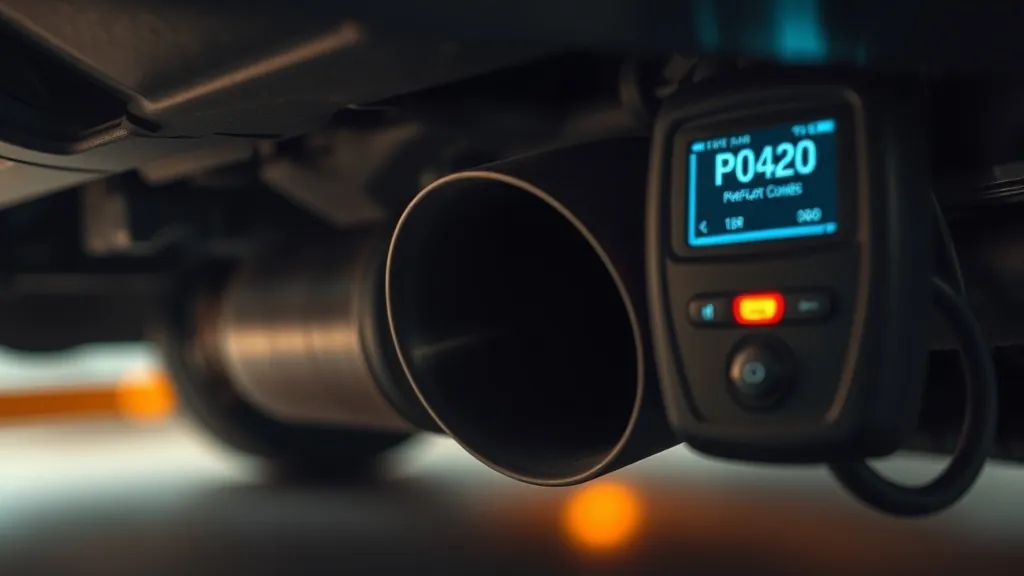
The P0420 code (sometimes written as engine code P0420) is one of the five most common OBD-II fault codes on the road today — and one of the most misunderstood. Here is everything the P0420 OBD-II code means, how serious it is, and how to fix it, before spending a single dollar.
What P0420 means
P0420 stands for “Catalyst System Efficiency Below Threshold (Bank 1).” The ECU uses two oxygen sensors — one before and one after the catalytic converter — to monitor how well the cat is converting exhaust gases. When the downstream O2 sensor starts mimicking the upstream one (indicating the cat is no longer storing and releasing oxygen efficiently), the ECU sets P0420.
Symptoms of a P0420 code
P0420 is unusual among OBD-II codes because it often has no noticeable symptoms at all beyond the warning light. The most common signs are:
- Check-engine light on — usually the only symptom, and steady (not flashing).
- Failed emissions / smog test — the most common reason drivers discover P0420.
- Slightly reduced fuel economy — in some cases, if the underlying cause is a failing O2 sensor.
- Faint sulfur (rotten-egg) smell — occasionally, when the catalytic converter is genuinely failing.
A flashing check-engine light or noticeable power loss points to a different problem (usually a misfire) — not P0420 on its own.
How serious is P0420?
Drivability: low to medium. P0420 typically does not cause rough running, reduced power, or immediate safety issues. Your car will drive normally in most cases. However, it will fail an emissions inspection, and ignoring it for extended periods can allow further damage.
Urgency: medium. Fix it before your next inspection, but you are not risking immediate breakdown. Do not pay thousands of dollars urgently based on this code alone.
What causes a P0420 code? (ranked by likelihood)
Do not assume P0420 means you need a new catalytic converter. In order of how often each cause is actually responsible:
| Likely cause | Typical cost to fix |
|---|---|
| Faulty downstream (post-cat) O2 sensor | $20–$80 part |
| Exhaust leak before the rear O2 sensor | $50–$200 |
| Bad fuel / single cold-start anomaly | $0 (clears on its own) |
| Engine burning oil or coolant (contaminates cat) | Varies — fix root cause first |
| Genuinely failed catalytic converter | $150–$2,000+ |
The catalytic converter is the most expensive cause but usually not the first one to check. Work through the steps below before replacing it.
Step 1: Clear it and see if it returns
Use the OBD2 Code Lookup tool to research P0420 for your specific make. Then clear the code and drive 50–100 miles. If it returns, you have a genuine issue. If it stays gone, it may have been triggered by a single cold start anomaly or bad fuel.
Step 2: Check the easy things first
- Exhaust leaks before the downstream O2 sensor — a cracked manifold or leaking flex pipe lets in extra oxygen, fooling the sensor. Inspect (or have inspected) before replacing the cat.
- Downstream O2 sensor — a failed post-cat sensor will falsely trigger P0420. A new sensor is $20–$80 vs a catalytic converter at $300–$2,000.
- Oil burning or coolant consumption — if your car burns oil or has a blown head gasket, contaminants will destroy a new catalytic converter quickly. Fix the root cause first.
Step 3: Replace the catalytic converter (if needed)
If the above checks pass and the code returns, the catalytic converter is likely past its service life (typically 100,000–150,000 miles). Aftermarket converters cost $150–$600 installed; OEM converters are $600–$2,000+. In California and other CARB states, only CARB-compliant converters are legal.
P0420 by make: Toyota, Honda, Subaru, Ford and Chevy
P0420 behaves the same way across manufacturers, but a few makes are known for it:
- Toyota & Lexus — high-mileage Camry, Corolla and RAV4 engines commonly log P0420 as the original catalytic converter ages past 150,000 miles. See our Toyota Camry HUD guide for catching engine data early.
- Honda — Civic and Accord frequently show P0420 from a lazy downstream O2 sensor rather than the cat itself. Our Honda Civic HUD guide covers OBD2 monitoring for these engines.
- Subaru — boxer engines that burn a little oil can foul the catalyst; fix oil consumption first. See the Subaru HUD guide.
- Ford & Chevy — full-size trucks and SUVs may set P0420 (Bank 1) or P0430 (Bank 2) as exhaust components age.
P0420 vs P0430 and related codes
P0430 is the identical code for Bank 2 (the other cylinder bank on V6/V8 engines). P0421 refers to warm-up catalyst efficiency. If you see P0420 alongside a misfire code (P0300–P0308) or a lean/rich code (P0171/P0172), fix those first — they are often the real cause of the catalyst damage. Look up any code for your make with the OBD2 Code Lookup tool.
Catch codes earlier with an OBD2 HUD
An OBD2 HUD shows live O2 sensor data and pending fault codes before they trigger the check-engine light. Catching a misfiring cylinder or a lean condition early prevents the catalyst damage that leads to P0420 in the first place.
As an Amazon Associate, HUDScreen earns from qualifying purchases. Pricing and availability are shown on Amazon and may change.
Our HUD picks
Three plug-in head-up displays, by what you want on the windshield.
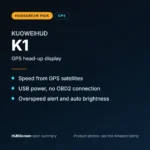 KUOWEIHUD K1 GPS Head-Up Speed DisplayGPS speed with no OBD2 port needed: fits EVs, hybrids and older cars.Check Price →
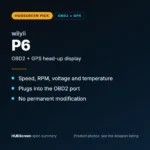 wiiyii P6 OBD2 + GPS Head-Up DisplaySpeed, RPM and temperature from the OBD2 port on compatible 2007+ gas cars.Check Price →
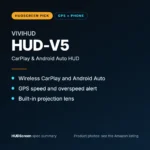 VIVIHUD HUD-V5 Wireless CarPlay & Android Auto HUDWireless CarPlay and Android Auto directions plus GPS speed.Check Price →
As an Amazon Associate, HUDScreen earns from qualifying purchases. Price, shipping and returns are set by Amazon and the seller.
Frequently asked questions
Can I drive with a P0420 code?
In most cases, yes — P0420 does not cause immediate drivability issues or safety risks. However, your car will fail an emissions test, and long-term neglect can damage other components. Address it before the next inspection.
Is P0420 expensive to fix?
It depends on the root cause. An exhaust leak fix is $50–$200. A replacement O2 sensor is $20–$80 parts. A catalytic converter replacement is $300–$2,000+ depending on OEM vs aftermarket and your state’s emissions rules. Always check the cheaper causes first.
Will a catalytic converter cleaner fix P0420?
Fuel-additive catalytic converter cleaners occasionally help on borderline cases — the cat is working but marginally. They are worth trying before replacement ($15–$30 vs $500+). They will not fix a cat that is physically damaged or structurally failed.
What is the P0420 OBD-II code?
P0420 is a standard OBD-II (OBD2) diagnostic trouble code meaning “Catalyst System Efficiency Below Threshold (Bank 1).” It applies to every OBD-II-compliant vehicle (US cars built since 1996) and is read from the same 16-pin port under the dashboard.
How many miles can I drive with a P0420 code?
There is no hard mileage limit — P0420 does not cause breakdown or safety risk on its own. You can drive normally for weeks or months, but you will fail an emissions test and should diagnose it before the next inspection. If P0420 appears with a misfire or power loss, stop driving and diagnose immediately.
What is the difference between P0420 and P0430?
They are the same fault on different engine banks. P0420 is Bank 1 (the side with cylinder #1); P0430 is Bank 2. Only V-configured and some flat engines have a Bank 2. The diagnosis and fixes are identical.