

A head-up display looks like magic the first time you see one: numbers floating over the road ahead, apparently hanging in mid-air beyond the bonnet. The mechanism is simpler than it looks. Here is how a car HUD actually works — the optics, the data, and why the image seems to sit out on the road rather than on the glass.
The short answer
A HUD projects a bright image upward from the dashboard onto a partially reflective surface — either the windshield itself or a small clear panel called a combiner. You see the reflection, but because the light is focused, your eyes perceive it as a virtual image floating several feet in front of the car rather than a picture painted on the glass.
The three parts of every HUD
- A data source. Where the numbers come from — GPS satellites, the car’s OBD2 port, or a paired phone.
- A projection unit. A small bright display (usually LED or LCD) plus a mirror or lens assembly that throws the image upward and focuses it.
- A combiner surface. The windshield, or a separate flip-up plastic panel. It has to reflect enough light toward your eyes while staying transparent enough to see through.
Why the image appears to float ahead of the car
This is the part that surprises people. The projection optics do not simply bounce a picture off the glass — they collimate the light, meaning the rays leaving the unit are close to parallel. Parallel light is what your eyes receive from distant objects, so your eye muscles focus as though the numbers were far away.
The practical benefit is real: your eyes stay focused near road distance instead of refocusing to dashboard distance and back. That refocusing is a large part of why glancing at a gauge cluster costs attention, and it is the core safety argument for a HUD. On factory systems the virtual image typically sits around 2–3 metres ahead; simple aftermarket units project closer, so the effect is weaker but still present.
Where the numbers come from
GPS. The unit calculates speed from its own change in satellite position. It needs no connection to the vehicle at all, which is why a GPS HUD works in any car, including pre-1996 vehicles and rentals. GPS speed is also typically closer to true ground speed than the dashboard gauge, which is legally allowed to read high.
OBD2. The unit plugs into the 16-pin diagnostic port and asks the engine computer for live values — speed, RPM, coolant temperature, voltage, fault codes. That is how an OBD2 HUD shows engine data a GPS unit simply cannot see. It requires a compatible vehicle: the port is standard on US cars from 1996, but most plug-in HUD listings cover gas cars from about 2004–2009 onward. See the full comparison in GPS vs OBD2 HUD.
A paired phone. Phone-connected units mirror navigation from your maps app. What they can and cannot do is covered in CarPlay & Android Auto head-up displays.
Factory HUDs vs aftermarket: the windshield difference
A factory HUD projects onto the windshield itself, and that windshield is built for the job: its plastic interlayer is wedge-shaped, slightly thicker at the top, so the reflections from the inner and outer glass surfaces overlap into one crisp image. Standard glass has a uniform interlayer, which is exactly why a HUD car fitted with the wrong replacement windshield shows a permanent double image — see HUD blurry after a windshield replacement.
Aftermarket units sidestep this. They either project onto a small combiner panel of their own, or onto a thin anti-reflective film you stick to the windshield in the projection zone. Both give the second reflection somewhere to go, which is why skipping the supplied film usually produces ghosting — covered in fixing HUD glare and ghosting.
Why brightness is the hard engineering problem
A HUD competes with daylight coming through the same piece of glass. To stay readable against a bright sky the projected image has to be very intense, and then dim dramatically at night so it does not dazzle. That is why an auto-brightness sensor matters more than raw specification numbers, and why cheap units that look fine in a showroom wash out at noon.
New to HUDs? Start with the HUD display for cars guide, or if yours is already fitted and misbehaving, the troubleshooting guide.
As an Amazon Associate, HUDScreen earns from qualifying purchases. Pricing and availability are shown on Amazon and may change.
Our HUD picks
Three plug-in head-up displays, by what you want on the windshield.
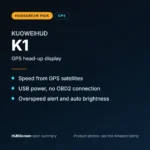 KUOWEIHUD K1 GPS Head-Up Speed DisplayGPS speed with no OBD2 port needed: fits EVs, hybrids and older cars.Check Price →
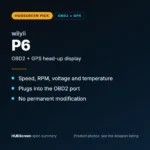 wiiyii P6 OBD2 + GPS Head-Up DisplaySpeed, RPM and temperature from the OBD2 port on compatible 2007+ gas cars.Check Price →
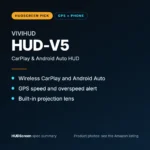 VIVIHUD HUD-V5 Wireless CarPlay & Android Auto HUDWireless CarPlay and Android Auto directions plus GPS speed.Check Price →
As an Amazon Associate, HUDScreen earns from qualifying purchases. Price, shipping and returns are set by Amazon and the seller.
Frequently asked questions
How does a head-up display work in a car?
A projector in the dashboard throws a bright image upward onto the windshield or a small clear combiner panel. The optics collimate the light so your eyes focus as if the numbers were far away, making the display appear to float over the road instead of sitting on the glass.
Does a head-up display project onto the windshield or a separate screen?
Both designs exist. Factory HUDs project onto the windshield, which is specially made with a wedge-shaped interlayer so the two glass surfaces do not produce a double image. Aftermarket units either use their own flip-up combiner panel or a supplied anti-reflective film applied to the windshield.
Why does the head-up display image look like it is in front of the car?
Because the light leaving the projector is collimated – the rays are nearly parallel, like light from a distant object. Your eyes focus at roughly road distance rather than dashboard distance, so the image is perceived as a virtual image several feet ahead of the car.
Do head-up displays work at night and in bright sun?
Good ones do. The display must be intense enough to compete with daylight through the same glass, then dim sharply at night to avoid dazzling the driver. An automatic brightness sensor is the feature that matters most; units without one tend to wash out at midday or glare after dark.