

No — as of 2026, no Tesla has a factory head-up display: not the Model 3, Model Y, Model S, Model X or Cybertruck. That is exactly why Tesla drivers search for a Tesla head-up display so often. Model 3 and Model Y have no instrument cluster at all: your speed lives on the centre touchscreen, off to the side of your natural sight line. An add-on HUD puts it back in front of you — and because Teslas have no standard OBD2 port, it should be a GPS unit (details below).
Does any Tesla have a factory head-up display?
No. As of 2026, no Tesla model — Model 3, Model Y, Model S, Model X or Cybertruck — ships with a factory head-up display. Model S and Model X have a driver-facing display behind the wheel, but that is an instrument panel, not a windshield HUD. For Model 3 and Model Y, an aftermarket HUD is the only way to get speed into your forward view.
The one thing to know before buying: Tesla and OBD2
This is where most Tesla HUD purchases go wrong. Tesla vehicles do not have a standard OBD2 port. Model 3 and Model Y use a proprietary connector behind a trim panel, and reaching the diagnostic data requires a Tesla-specific adapter harness. An ordinary OBD2 HUD has nothing to plug into.
So for a Tesla, choose a GPS head-up display. It reads speed from satellites, needs only 12 V or USB power, and works identically in every Tesla regardless of model or year.
Best Tesla HUD: KUOWEIHUD K1
The KUOWEIHUD K1 is our recommendation for any Tesla. Plug it into the console USB port or 12 V outlet, place it low and centred on the dash, and you get GPS-accurate speed in your line of sight — no OBD2 adapter, no coding, no permanent changes.
Want navigation in your sight line too? VIVIHUD V5
Teslas don’t support Apple CarPlay or Android Auto on the touchscreen. The VIVIHUD V5 works around that on its own screen: your phone connects to the HUD itself over Wi-Fi and Bluetooth, and it shows CarPlay or Android Auto navigation plus GPS speed on its built-in lens. Your Tesla’s touchscreen doesn’t change, and to keep audio on the car speakers you connect your phone to the car’s own Bluetooth as usual. It reads no vehicle data, is about 10 inches wide, and powers from a 12 V socket or its OBD power cable.
Model-by-model notes
- Model 3 — the strongest case for a HUD in the whole Tesla range. No cluster at all, and the centre screen sits far to the right of your sight line. A GPS HUD restores a conventional speed readout.
- Model Y — identical interior architecture to Model 3, so the same reasoning and the same GPS recommendation apply. The taller dash gives a slightly larger flat area for placement.
- Model S / Model X — these do have a driver display, so a HUD is a smaller upgrade. It is still useful if you want speed on the glass rather than behind the wheel.
What about dedicated Tesla HUD products?
Several brands market Tesla-specific dash displays that tap the car’s internal data bus through a trim-panel connector. They can show battery and drivetrain data a GPS unit cannot, but they involve dismantling interior trim and connecting to a proprietary port — more risk, more cost, and a real chance of interfering with future software updates. For speed visibility alone, a GPS HUD achieves the goal with none of that.
For EVs from other manufacturers, see our guide to HUDs for electric cars, or check every 2026 car with a factory head-up display.
As an Amazon Associate, HUDScreen earns from qualifying purchases. Pricing and availability are shown on Amazon and may change.
No factory HUD? Add one
These plug-in head-up displays work in cars without a factory HUD. Choose by what your car can supply.
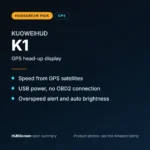 KUOWEIHUD K1 GPS Head-Up Speed DisplayGPS speed with no OBD2 port needed: fits EVs, hybrids and older cars.Check Price →
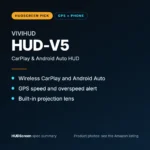 VIVIHUD HUD-V5 Wireless CarPlay & Android Auto HUDWireless CarPlay and Android Auto directions plus GPS speed.Check Price →
As an Amazon Associate, HUDScreen earns from qualifying purchases. Price, shipping and returns are set by Amazon and the seller.
Frequently asked questions
Does the Tesla Model 3 have a heads-up display?
No. The Model 3 has no instrument cluster and no factory head-up display — speed is shown only on the centre touchscreen. This is why an aftermarket GPS HUD is one of the most common Model 3 accessories: it puts speed back into the driver’s forward line of sight.
Does the Tesla Model Y have a HUD display?
No Model Y trim includes a factory head-up display. The Model Y shares the Model 3’s screen-only layout, so a GPS-based aftermarket HUD is the standard solution and works in every model year.
Can you use an OBD2 HUD in a Tesla?
Not without a Tesla-specific adapter. Teslas do not have a standard OBD2 port — Model 3 and Model Y use a proprietary connector behind interior trim. A GPS head-up display avoids the problem entirely because it takes speed from satellites and needs only power.